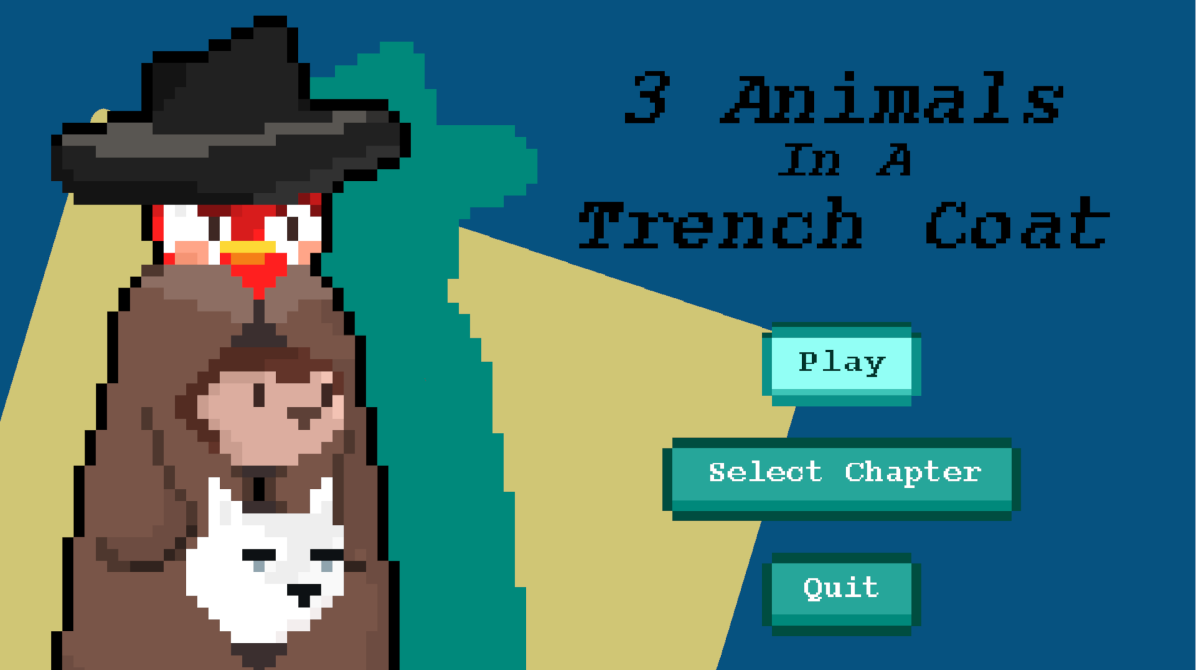
A top-down 2D puzzle adventure game with stealth elements. The player
plays as three animals (parrot, monkey, dog), stacked on top of each
other in a trench coat, who accidentally joins a spy organization.
They must solve puzzles while hiding their identities.
Jenise Cheung - Character Artist, Game Designer, Level Designer
Jillian Li - Game Developer, Game Designer, Level Designer
Tools
Aseprite
Unity
FigJam
Timeframe
14 weeks [January - April 2024]
Focus + Role
The goal of this project was to design and create an
experimental game focused on creating distinctive scenarios through
use of narrative and game mechanics. My focus was to create unique scenarios that could only be solved through the use of these mechanics. I designed puzzles, map layouts, and illustrated the background art for the game.
Puzzle Design
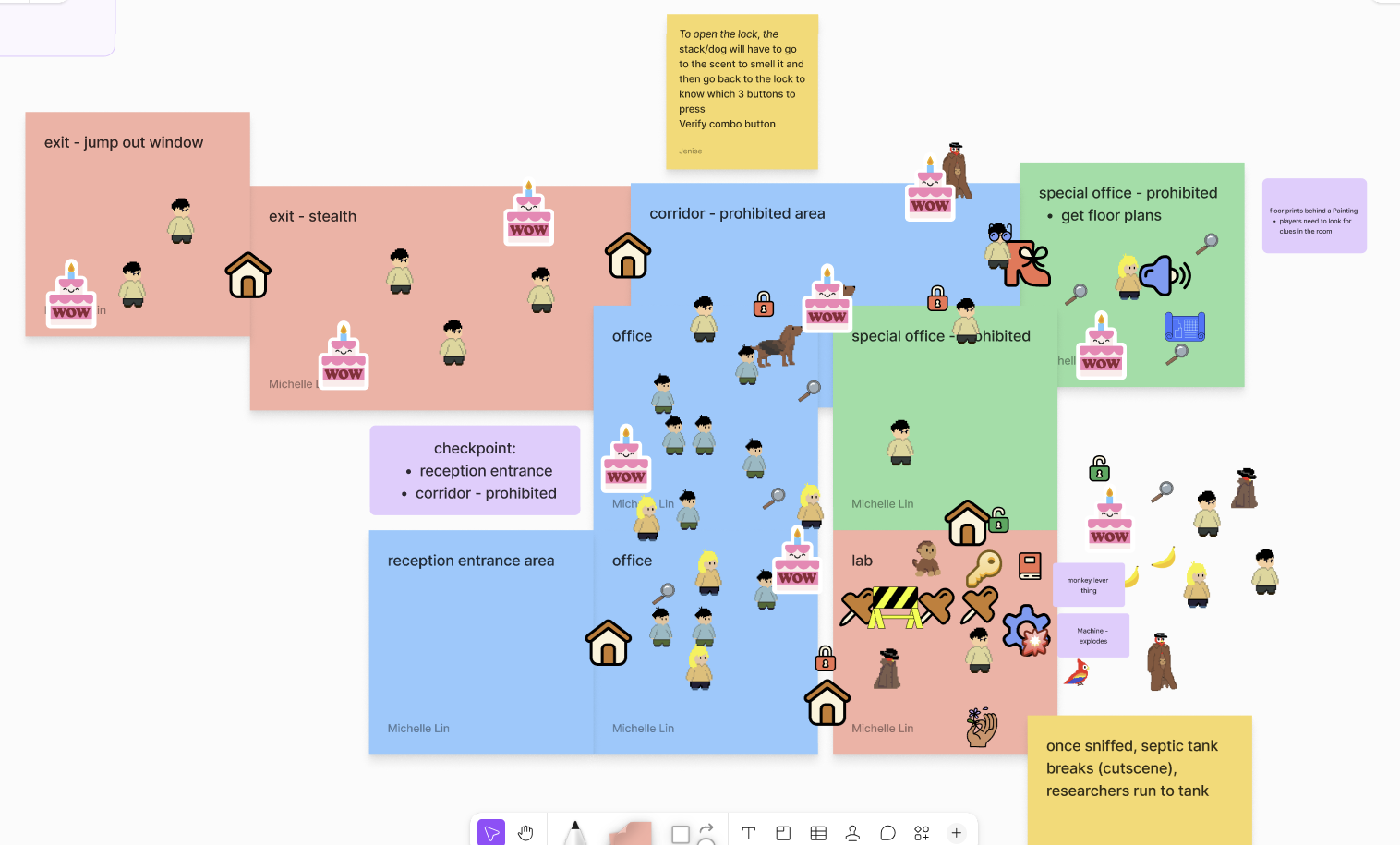
The main mechanic of the game is that the player controls 3 animals stacked on top of each other with the ability to split one animal away from the stack to solve puzzles. During ideation, we collaborated in a FigJam file using sticky notes and get a feel for the general layout of the map.
In the environmental design, I focused on ensuring that players
knew where to go, what was interactable, and what the points of
interests were. This was important as many of our puzzle clues
were either embedded into the environment or required the player
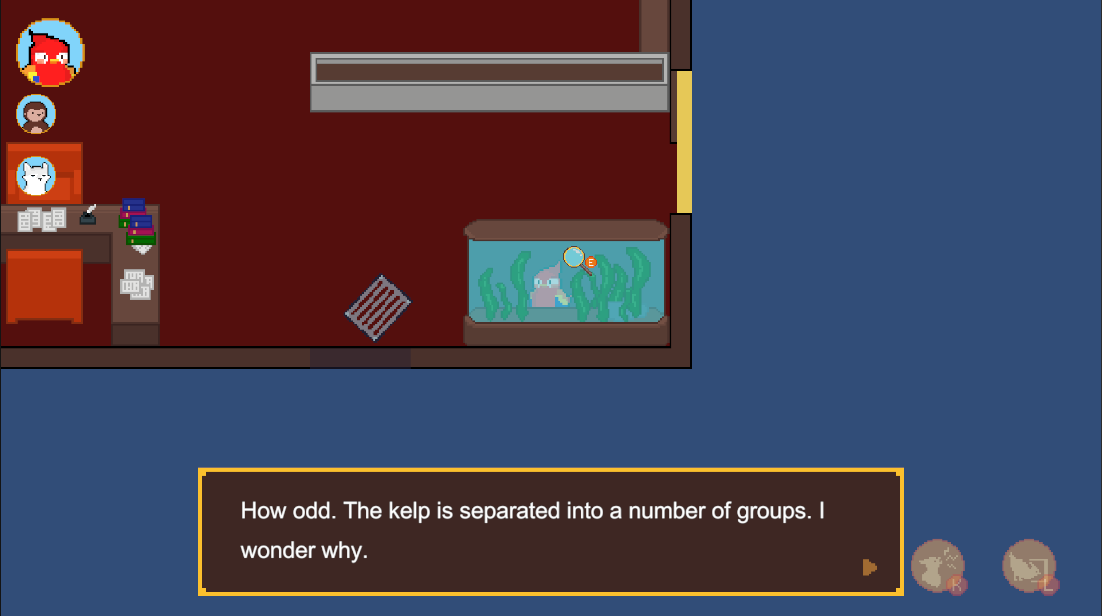
to investigate specific areas in the map. the tank is investigated
for a clue relating to the kelp in the tank.
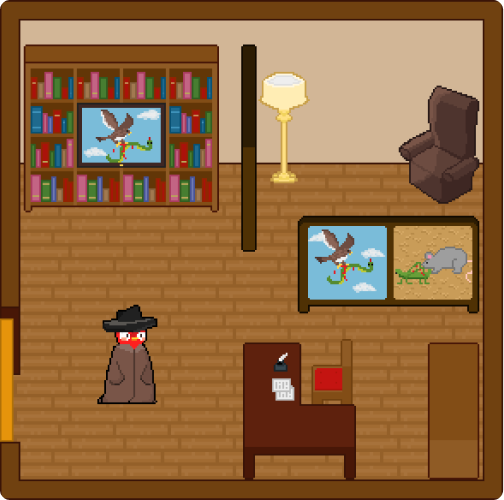
To do this, I made points of interests “pop out” of the
environment more through the use of bright colours or through
placing interesting objects, like the desk with papers.
Level concept ideation done in FigJam. Designed to utilize all 3 animals' abilities.
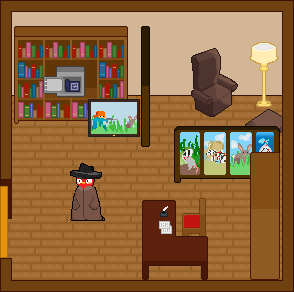
Objects of interest, like the paintings, are made to "pop out" through contrasting colours.
An example of an embedded clue, the 2 groups of kelp in the tank, in the environment.
Challenge
We conducted playtesting sessions where we received several critiques that one the puzzles was too difficult and that it was hard to see the details of its visual hint. To solve this, I changed the imagery in the divider and painting so its larger and contains a clearer connection to the textual hint. The shelf in the room was lowered so the player can see the entire divider. An additional text hint "The divider depicts the struggles between predator and prey. The owner of this office sure has interesting taste in decor." was added instead of relying solely on the visual clue.
In the after, the imagery on the divider is larger and contains a clearer connection to the given text hint. The painting on the safe repeated the same image to indicate importance. After the change, playtesters were able to make the connection between the text hint and the visual clue, and solve the puzzle without needing additional hints.
Before: The visual clue was the divider in the middle-right side of the room. It was too small to see the details clearly.
After: The imagery on the divider is larger and contained a clearer connection to the given text hint.
Reflection
This project was a great learning experience as it was the first time designing a game. Through working on this project, I’ve improved my skills in level design and environmental art. As this was the first time I’ve created environments, I’ve learned more about the process of designing intuitive levels.
I’ve learned the importance of playtesting throughout each stage of the project. With each session, I am able to make modifications earlier, preventing the problem of having to create larger changes down the line. Also, I’ve improved my level design skills through iterative testing, identifying areas of concern and finding ways to resolve them.
In the future, I would incorporate more narrative elements into the background as it mostly contains necessary devices to proceed through the game. Adding more life into the maps would help deliver background information as well as increase player engagement. In addition to that, I would like to create a better distinction between interactable objects and non-interactables.